The Tribe's stagnant scavenger society
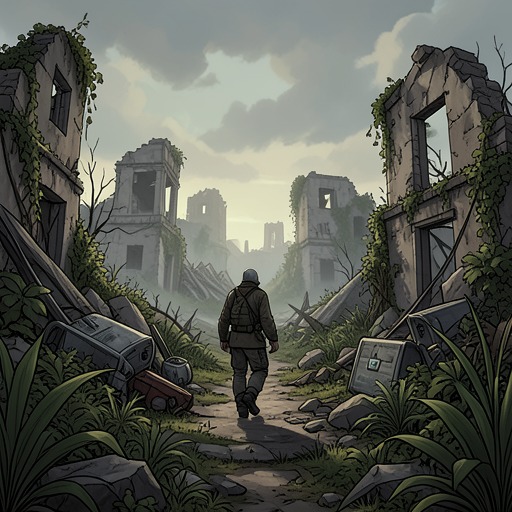
Earth AbidesThe Tribe's stagnant scavenger society is the post-disaster community’s long dependence on the material leftovers of the Old Times, a way of life that preserves its members while postponing the work of making a durable future. Ish sees the danger plainly: inherited supplies will not last, and a society that consumes without learning to produce risks leaving its children unable to manage when those supplies fail. Yet the community’s inertia is not simply a refusal to listen. The Great Disaster has reduced human life to a small, vulnerable group, while food and shelter remain close at hand and the failures of the old systems unfold slowly. The result is a tension between survival in the present and preparation for a future the community can barely imagine.
Dependence on the Old Times
In the immediate aftermath of the Great Disaster, civilization appears to have retreated without vanishing at once. People had died in enormous numbers, but reports described organized medical care, emergency food distribution, and authorities enforcing immediate mass burials. Even water, light, power, and telephone service continued in many cities. Such arrangements made the catastrophe seem survivable through the remaining machinery of the old society, even as the people who had operated it were disappearing.
The Power-and-Light system demonstrates how misleading that continuity was. Its generators continued sending power through the wires after the workers fell sick, and the interconnected network compensated when a line or power-house failed. But its governors still required regular inspection and oil. With maintenance abandoned, oil supplies dwindled; governors failed one by one, diverting water away from generator wheels until the generators stopped. The system’s apparent resilience depended on repeated human work that had become invisible precisely because it had once been routine. Its cumulative failure foreshadows the Tribe’s own problem: inherited structures can continue to serve people for a time without teaching them how to renew what they use.
The same dependence is visible in everyday surroundings. On San Lupo Drive, unswept leaves blocked a drain-pipe. Rainwater crossed the street, flooded the Harts’ lawn and house, cut a small gully through the rose-garden, and eventually reached a storm sewer. Ish could have cleared the blockage in minutes, but saw no point in doing so when countless similar failures must be occurring elsewhere. Roads, drains, and walls had never been self-sustaining; their continued usefulness had rested on routine cleaning and repair. The small obstruction matters because it makes large-scale decline legible as a multitude of unattended local tasks.
A community that does not yet act
By the time the community has endured the first years of rebuilding, Ish had hoped that survivors would restore at least some functions of civilization. He had imagined electric lights returning. Instead, the Tribe remains dependent on the leavings of the past. He regards its members as the human material from which a new civilization might be made, but that possibility has not yet become a shared program.
In his living room, Ish finally gives voice to the gap between what the Tribe consumes and what it creates. He warns that scavenged supplies will eventually run out, perhaps not in his lifetime but in the lives of his children or grandchildren. Food may still be obtainable from cattle and rabbits, he argues, but more complicated necessities will pose a harder problem. Even the example of a refrigerator, which the group has discussed without acting on it, becomes a sign of a broader habit: talk substitutes for experiment and practical effort.
His proposals are concrete. The Tribe should obtain more domestic animals than dogs, grow more of its own food rather than continue raiding old grocery stores, and teach the children to read and write more fully. Ish stresses that the children need skills, not merely continued access to stored goods. The appeal briefly seems to move his listeners, and Joey responds with visible excitement. Then the gathering’s applause proves largely ironic; Roger treats the speech as a familiar performance. Ish’s authority as the community’s longtime leader has not given him the power to convert agreement into sustained work.
The occasion ends socially rather than politically. Ish raises a toast to law and order, an old phrase that amuses the older people but means little to the younger ones. He hopes his speech has planted a seed, yet doubts that it will produce action before an unpleasant emergency forces the issue. The contrast between his vision and the group’s response is central to the stagnation: the problem is recognized, even discussed, but its future costs remain less compelling than the convenience of present life.
Why stagnation persists
Ish considers more than one explanation for the community’s inaction. Perhaps people remain in shock after the destruction of their former society, as groups in his anthropological reading have sometimes lost the will to readjust when their traditional way of life disappears. Or perhaps the mild climate and readily available food offer too little immediate stimulus to change. The questions prevent the Tribe’s behavior from being reduced to simple laziness: its members are living after a rupture so severe that familiar measures of progress and necessity no longer apply.
Ish also recognizes that the group is not merely an abstract social experiment. He begins by observing the community as a student might, but understands that its members are individuals whose needs and attachments cannot be separated from the forces shaping society. After twenty-one years, changes in the natural world have slowed enough that they no longer demand his day-to-day attention; the adjustment and reconstitution of human society have become his chief intellectual concern. At the same time, he cannot remain only an observer. In a community of just thirty-six people, the thinker’s ideas may give him an influence out of proportion to the community’s size, and the others are likely to turn to him in a real emergency. That position makes the failure to persuade them personally consequential, not merely an object of study.
The natural environment supplies shocks that expose the costs of relying on a narrow, improvised economy. In the Year of the Bulls, cattle have multiplied until they are a nuisance; people must learn to step aside from charging bulls, and sometimes shooting one creates the further problem of disposing of its carcass. The following year, drought leaves little grass. Hungry cattle break through the fence around the small vegetable plot and trample it in the confusion, destroying the garden without even eating its produce. Grasshoppers then consume what the cattle have not reached, including tree leaves and ripening peaches. The linked losses show how vulnerable a small food supply can be to ecological pressures that the Tribe neither controls nor has prepared against.
Rain brings relief: two weeks after the first downpour, the hills are faintly green with new grass, and Molly and Maurine weep with pleasure. Ish, too, feels relieved, having begun to doubt whether any seeds remained. The recovery shows that the earth can renew itself, but it does not remove the community’s dependence or establish the habits Ish has urged. Environmental recovery and social preparation are different kinds of resilience; the first can arrive with the rain, while the second requires deliberate learning and collective effort.
Change under pressure
The reservoir crisis gives a sharper form to the danger that Ish had described in general terms. A defective section of steel pipe in the main aqueduct had passed inspection despite known imperfections. A foreman noticed a leak shortly before the Great Disaster, but the pipe was patched and continued to function. In the years without maintenance, the small leak gradually enlarged. Heavy rains after New Year’s slow the reservoir’s decline, but the mid-winter dry spell returns; water flows away through open faucets, leaking joints, and broken pipes until a reservoir gauge that had shown a depth of twenty feet records only a thin covering at the bottom. The crisis is not a sudden failure of one conspicuous machine but the accumulated consequence of defects and losses left unattended.
Even so, change remains uneven. The Tribe’s stagnant habits persist after Ish’s warning: weeks pass without men carrying the refrigerator uphill or preparing a garden plot. Ish worries at times, but daily life continues, and he himself does not maintain constant urgency. The sequence captures the force of an easy present: without a pressing immediate demand, even people who understand the problem can drift back into routine.
By Year 34, however, a proposal from a smaller community living north across the Bay forces a decision. The newcomers send a messenger to propose a union, and Ish keeps him at a distance while gathering information, wary of repeating the Charlie affair. At the meeting, fear of disease and prejudice against unfamiliar customs contend with the desire to strengthen the Tribe’s numbers and the need for wives, as fewer girls have been born in recent years. Ish and Ezra oppose the union, while the oldest younger men remember the Year 22 and support them. Ish also sees that marriage within the Tribe has become universal cousin marriage, making continued isolation a possible danger in itself.
Em answers the debate by insisting that life cannot be preserved simply by refusing its risks: their sons and grandsons will need wives, and the possibility of death must also be faced. Her words give the gathering courage, and the members vote unanimously to admit the others. This time the feared epidemic is limited to measles among the newcomers, who soon recover. The decision does not erase the Tribe’s long dependence on the past, but it shows that its collective choices can change when the costs of isolation become more immediate than the risks of contact.
Significance
The Tribe’s stagnation is sustained by two forms of inherited ease: material abundance left behind by the Old Times and social routines that allow each day to proceed without confronting the future. The novel places that ease beside systems whose continuity once depended on human maintenance, from power generators and aqueduct pipes to drains and gardens. Their failures accumulate gradually, often beginning with small oversights rather than a single dramatic collapse.
Ish’s repeated efforts to turn foresight into practical work reveal the limits of individual leadership. He can identify the danger, propose specific remedies, and imagine what the next generation will need, but he cannot make the community move simply by explaining the consequences. The years of inaction and the later decision to admit the other group together show a society neither wholly fixed nor steadily advancing: it may postpone change while conditions are comfortable, then respond when a concrete pressure makes an old assumption untenable. That unevenness gives the Tribe’s dependence on scavenging its central significance. Survival has carried the community beyond the first disaster, but survival alone does not guarantee the ability to make a future.